
Property isn’t the only route to European residence. European residency without real estate investment may be possible through qualifying funds, business activity, or contributions. Greece, Hungary, and Bulgaria have no minimum physical-presence requirement for residence by investment, while stay conditions vary across other routes.
Compare more than the initial investment. How often you must be in the country, which eligible family members can join you, and the overall costs can all affect your choice. A route suited to someone seeking to limit visits may not fit someone whose main goal is to build and operate a business in Europe.
This comparison explains how non-property routes differ in minimum stay, physical presence, family inclusion, and costs, with key distinctions for readers in the UAE. It also compares business and talent-based pathways with investment options, helping you focus on routes that suit your plans and practical commitments.
Key Takeaways
- Compare required time in-country separately from the conditions for keeping a permit; they can affect your travel plans in different ways.
- Understand what a residence permit allows for family members, including the limits on short-term travel within the Schengen Area.
- Assess the full application budget by separating the qualifying route from application charges and costs that may depend on family size.
- Use your priorities to narrow the options: business and talent pathways may suit a different profile from fund-based or contribution routes.
Minimum-stay requirements
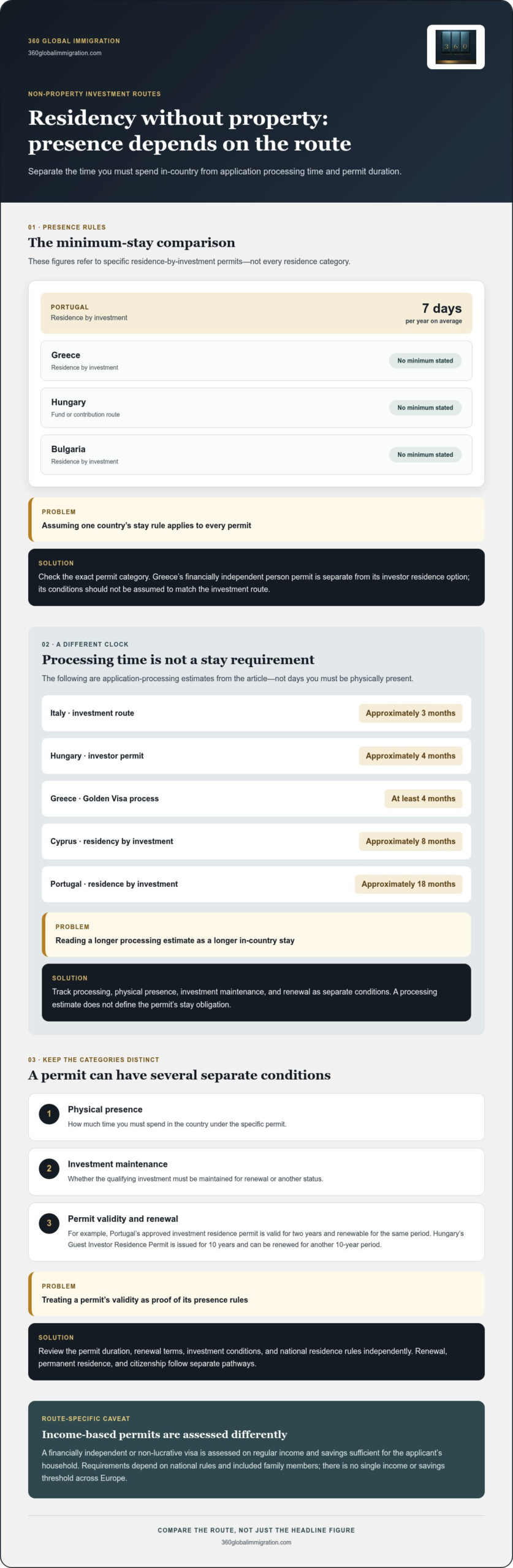
European residency without real estate investment may involve fund, business, and contribution routes, but minimum presence depends on the country and permit. Portugal’s residence-by-investment program requires an average stay of seven days per year. Greece, Hungary, and Bulgaria have no minimum physical-presence requirement for residence by investment.
These figures apply to specific investment permits, not every residence category. A financially independent or non-lucrative visa is assessed based on regular income and savings sufficient for the applicant’s household. Requirements depend on national rules and the family members included; there is no single income or savings threshold across Europe.
Greece’s financially independent person permit is distinct from its golden visa. Residence and cost conditions depend on the permit category, while the investment program has no minimum presence requirement. Do not treat a financially independent permit as an investment route or assume its conditions match those of Greece’s investor residence options.
| Option | Minimum physical presence | Route type |
|---|---|---|
| Portugal residence by investment | Seven days per year on average | Eligible non-property investment routes |
| Greece residence by investment | No minimum stated | Investment route; financially independent permits are separate |
| Hungary residence by investment | No minimum stated | Fund or contribution route |
| Bulgaria residence by investment | No minimum stated | Investment route |
Minimum investment amounts also vary by route. Portugal offers fund and cultural contribution options, while Hungary offers fund-based routes. Italy includes an innovative startup route. Cyprus permanent residence requires investment in an eligible option, including company share capital. Malta’s permanent residence programme involves qualifying property purchase or rental, so it does not fit a strict no-property comparison.
Rules can change: Spain’s Residence by Investment Program concluded on 4 April 2025, and residential property ceased to qualify for Portugal’s Golden Visa after reforms in October 2023. Compare permit conditions, investment structure, and presence before considering citizenship. Choose the route that matches your capital plan and the time you can spend in the country.
Physical-presence requirements for European residence permits
Physical presence and permit validity are separate conditions. A residence permit may remain valid for years, while renewal or permanent residence can depend on maintaining the qualifying investment and meeting national residence rules. A property-based permit does not automatically require full-time residence: Greece’s Golden Visa provides a five-year permit, and the qualifying property must be held for five years.
Processing schedules add another planning factor. Current estimates range from approximately three months for Italy’s investment route and four months for Hungary’s investor permit to approximately 18 months for Portugal’s residence-by-investment route. Greece’s Golden Visa process lists at least four months. Cyprus residency by investment takes approximately eight months. These are application timelines, not physical-presence requirements.
Hungary’s Guest Investor Residence Permit is issued for 10 years and can be renewed for another 10-year period. Its direct real estate investment route was abolished in January 2025, so the permit now depends on an eligible non-property route. Cyprus and Portugal also illustrate why an investment threshold should not be confused with a stay obligation: the qualifying investment, permit validity, and residence conditions are distinct parts of the immigration process.
Renewal, permanent residence, and citizenship follow separate pathways. Portugal’s approved investment residence permit is valid for two years and renewable for the same period; Golden Visa holders may qualify to apply for citizenship after five years, subject to statutory conditions including language proficiency. Hungary may grant permanent residence after three years of lawful stay, with citizenship eligibility listed after eight years on its stated pathway. Italy’s citizenship eligibility period is 10 years of residence.
A residence permit issued by a Schengen country allows visa-free travel within the Schengen Area for up to 90 days in any 180-day period, but it does not itself authorize work or long-term residence elsewhere. Compare the permit’s duration, renewal terms, and presence rules alongside the investment structure. For a business-based route in Cyprus, explore the Cyprus Business Residence Visa.
Family inclusion
Family eligibility is a separate consideration from investment capital or property purchase. Assess who can receive a linked residence permit, what evidence each person needs, and how their travel rights work.
Family Eligibility
For each golden visa or business-based route, identify whether the application can include a spouse, children, or dependent parents. Eligibility categories and evidence requirements are set by the destination country, so do not assume that one European permit’s family rules apply across other countries. Compare the route’s permitted family members before deciding how to allocate capital or select an investment.
Residence Conditions for Family Members
Family members’ permits are linked to the principal applicant’s route, but their residence conditions should be reviewed individually. Map each person’s permit validity, renewal requirements, and presence obligations alongside the main applicant’s. This helps distinguish family members planning to live in the destination from those prioritising lawful status while travelling.
A residence permit issued by a Schengen member state allows visa-free travel within the Schengen Area for up to 90 days in any 180-day period. The permit does not itself grant the holder a right to work or reside long-term in another country. A family’s residence rights in the issuing country and its short-stay travel rights across the Schengen Area are therefore different matters.
Use a family-by-family checklist before choosing a non-property route: record each applicant’s relationship to the principal applicant, supporting documents, permit duration, and renewal conditions. Then compare the full application structure with the route’s qualifying capital or contribution. Property is not the only way to pursue residence, but avoiding real estate does not determine which relatives qualify.
Schengen permits allow visa-free travel to 29 European countries, but that benefit is not a substitute for a separate residence permit where a family member plans to live or work long-term. Keep each person’s passport details and application documents aligned with the intended route, and distinguish travel convenience from residence eligibility when comparing options.
Costs and additional application charges
Budget for more than the qualifying investment. A European residence application can involve government charges, document preparation, translation, and costs for each applicant, such as a spouse. The total depends on the route and application structure, so compare cost categories rather than treating the investment threshold as your full budget.
Processing time also affects planning. Residence-by-investment applications may take around 3-4 months in some countries and 12-18 months in others, partly because of backlogs and application completeness. Current estimates include approximately 3 months for Italy’s investor route, 4 months for Hungary, and 18 months for Portugal. These are processing estimates, not a promise of approval or a measure of total cost.
Due diligence is a core stage, not an optional extra. Authorities assess the applicant, source of funds, and supporting records under the selected program. If you are a foreign applicant managing finances across countries, prepare consistent evidence showing where the capital originated and how it moved. Missing or conflicting records can slow an application and complicate review of your status.
Follow a clear sequence: select an eligible route, confirm its investment structure, assemble identity and financial records, then submit a complete application. Greece’s Golden Visa, for example, has an application processing fee, while family applications may involve additional charges. Keep government fees separate from investment capital and professional support costs in your budget.
For a business-based alternative, the Cyprus Business Residence Visa focuses on a different application basis from investor programs. Compare the route’s requirements, family circumstances, and processing schedule before committing funds. To discuss an Ireland business residence pathway, explore business residence options.
360 Global Immigration: France Passeport Talent
360 Global Immigration helps applicants assess the France Passeport Talent when a professional or business pathway fits better than purchasing property. The key decision is whether your profile and plans align with the route’s qualifying criteria, rather than simply comparing investment thresholds or minimum stays.
For other business-led plans, the consultancy also supports the UK Innovator Founder Visa, Netherlands Self Employed Visa, and Cyprus Business Residence Visa. Comparing these pathways can help you focus on the destination and application type that match your intended work or business activity. Each program has its own eligibility requirements and residence conditions, so the route should follow your circumstances.
Contact 360 Global Immigration to discuss which pathway may suit your plans, or visit 360globalimmigration.com.
Choose a pathway that fits your next chapter
Choosing European residency without real estate investment means matching your long-term plans to the route’s purpose, not simply choosing the lowest threshold. Consider whether you intend to build a business, pursue a talent-based opportunity, or establish self-employed activity. This starting point can focus your comparison and clarify which eligibility criteria to examine first.
For applicants exploring professional and business pathways, 360 Global Immigration offers the France Passeport Talent, UK Innovator Founder Visa, and Netherlands Self Employed Visa. These options serve different profiles, so the useful next step is to discuss how your background and objectives relate to each route before preparing an application.
Contact 360 Global Immigration to discuss your options and identify a suitable direction for your European plans. A clear, informed choice can make the next stage feel more manageable.
Frequently Asked Questions
Which European countries offer residency permits without buying real estate?
Portugal, Hungary, Italy, Greece, Cyprus, and Bulgaria have investment routes that can use non-property options. Portugal includes eligible funds, research, and cultural contributions; Hungary offers a qualifying fund route; Italy has startup, company, bond, and philanthropic options. Greece includes fund and business investment routes, while Cyprus offers investment in company share capital. Bulgaria has a qualifying fund route.
Which European residency programs allow qualifying through business investment, funds, or donations?
Options include Portugal’s eligible fund, research, and cultural contribution routes; Hungary’s approved fund route; and Italy’s innovative startup, company, government bond, and philanthropic routes. Greece offers business investment and fund categories, while Cyprus has a company share-capital route. These programs accept different kinds of capital or contributions, so compare each route with your investment purpose.
How do European residency programs compare on fees, taxes, and minimum stay requirements?
Compare government application charges separately from qualifying capital, professional costs, and any tax obligations. Minimum presence varies by program, and permit status alone does not establish tax residence. The comparison provided for residence by investment describes tax residency as usually based on spending about 183 days per year in the country. Your tax position depends on where you live and your circumstances.
Can family members be included in European residency applications without real estate investment?
Some investment programs allow family applications, but eligible relatives and their conditions depend on the country and route. Assess the principal applicant’s eligibility alongside the rules for each relative, then account for any additional application or contribution requirements. For travel, a residence permit issued by a Schengen member state allows visa-free visits within the area for up to 90 days in any 180-day period.
What are the application steps, processing times, and documents for European residency permits?
Start by choosing a qualifying route, then prepare identity records, supporting evidence for the chosen investment or activity, and documents for any included relatives. Applications may involve checks on the applicant and the source of funds. Processing estimates include approximately 3 months for Italy, 4 months for Hungary, and 18 months for Portugal; backlogs and application completeness can affect timelines.
What are the minimum investment amounts for European residency options that do not require real estate?
Examples include €250,000 for Portugal’s cultural contribution route and Hungary’s fund or donation route; €500,000 for Portugal’s fund route; €250,000 for Italy’s startup route; €300,000 for Cyprus company shares; and €250,000 for Greece’s startup route.