
The right business visa route depends less on the visa label and more on what you plan to do. A short visit for meetings is different from relocating to build or operate a business, and choosing between them can feel confusing when each destination sets its own criteria. Business visa services can help you assess that distinction before you begin preparing an application.
That uncertainty is understandable. An application must reflect your purpose, professional profile, and destination. Missing information or inconsistent documents can complicate preparation, so start by setting out your plans rather than guessing from a route’s name.
This guide explains how business visa services can help you compare options and prepare for the application journey. You’ll learn how visit visas differ from business residence pathways, what factors may shape route eligibility, and which stages call for careful preparation. We’ll also introduce options supported by 360 Global Immigration, including the UK Innovator Founder Visa, France Passeport Talent, the Netherlands Self-Employed Visa, and business residence routes for Cyprus, Ireland, and Denmark. A structured approach can help you understand which pathway aligns with your plans and what to consider next.
Key Takeaways
- Business visa services can help organise route assessment and application preparation, but a business visit and permission to reside for business purposes serve different goals.
- Compare pathways by your intended activity, business model, destination, and residency objective rather than by visa title alone.
- Published programme criteria are one part of the assessment; your circumstances and supporting evidence also matter.
- A structured preparation process helps you define your goal, assess a route, organise documents, review the application, and submit it.
- Professional guidance can bring clarity to your options and application preparation, but it cannot guarantee an outcome.
Business Visa Services: What Support Do They Actually Provide?
Business visa services guide applicants through choosing and preparing for a business-related immigration route. The right route depends on the destination, intended activity, and applicant’s profile. That support can bring structure to a process involving unfamiliar terminology, evidence requirements, and distinct application stages. Begin by defining your goal: travelling for professional activities is not the same as seeking permission to live in another country on a qualifying business basis.
The label “business visa” covers different purposes and rules across destinations. A general overview of common visa purposes appears in What is a Business Visa?, but it doesn’t replace current instructions from the relevant immigration authority. Official rules determine which activities a route permits and what conditions apply.
Business visit or business residence: which goal are you pursuing?
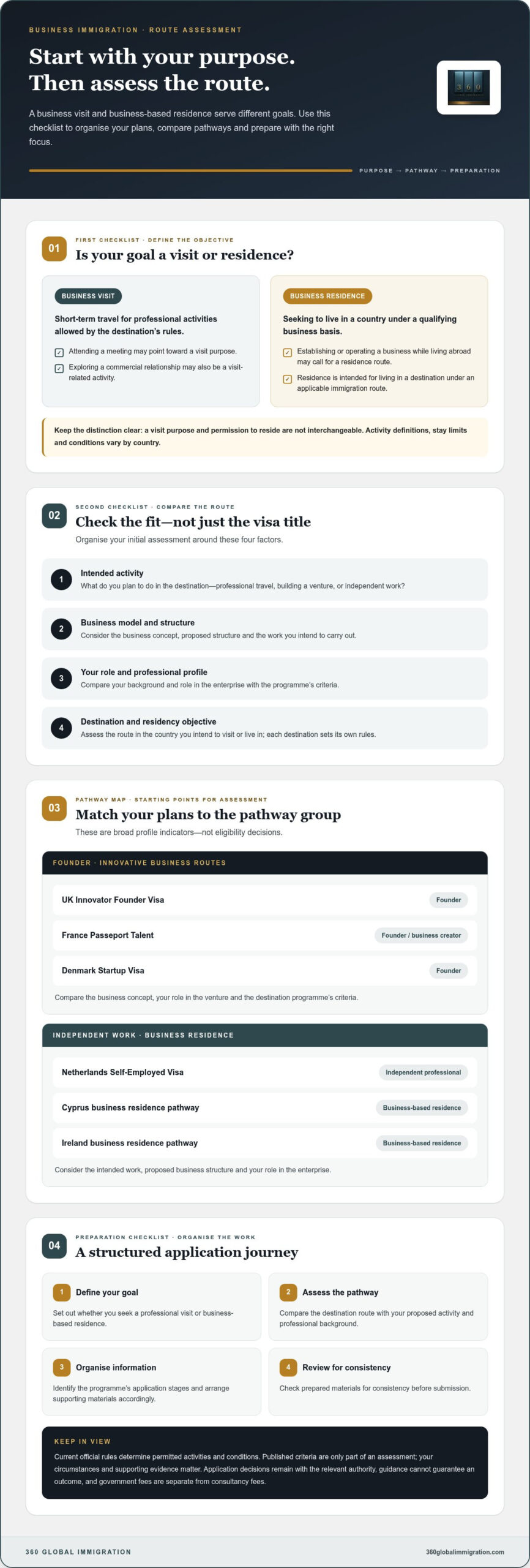
A business visit generally involves short-term travel for professional activities allowed by the destination’s rules. A business residence pathway is for applicants seeking to live in a country under a qualifying business basis. These are distinct objectives, not interchangeable labels. A visit supports permitted professional activity during travel; residence is intended for living in a destination under an applicable immigration route.
For example, attending a meeting or exploring a commercial relationship may point toward a visit purpose, while establishing or operating a business while living abroad may call for a residence route. These examples don’t establish permission. Activity definitions, stay limits, and conditions vary by country, so review current official rules before making plans.
What can a business immigration consultancy help organise?
A consultancy can help clarify which pathways may align with your plans and profile, explain application stages, and organise the information and materials needed for preparation. Start by identifying your destination and intended purpose, then structure preparation around the relevant programme rather than relying on a generic checklist.
Structured guidance can help you:
- Set out whether your goal is a professional visit or business-based residence.
- Compare a destination pathway with your proposed activity and professional background.
- Identify the programme’s application stages and organise supporting information accordingly.
- Review prepared materials for consistency before submission.
The distinction matters because an application prepared for the wrong purpose may not address the route’s actual requirements. Application decisions remain with the relevant authority, and government fees are separate from consultancy fees.
For example, a professional visit visa and a business residence application call for different route assessments and preparation. 360 Global Immigration supports both visit visa applications and business and talent-based residence pathways, with guidance shaped around the applicant’s plans and destination. The aim is a clearer, more orderly process, not a promise of approval.
Which Business Immigration Pathways Could Match Your Plans?
Start with the work you intend to do, not the name of a visa. A founder developing a new venture, a professional working independently, and an established business owner may need to assess different pathways, even if they share a destination. Business visa services can help organise this comparison around your plans and background, without treating a route name as proof that you qualify.
The options below are business and talent-based pathways supported by 360 Global Immigration. The profile descriptions are starting points for assessment, not eligibility decisions. Programme rules, terminology, and application processes can change, so review current requirements from the destination’s official authority before relying on them.
Founder and innovative business routes in the UK, France, and Denmark
For a founder, the UK Innovator Founder Visa, France Passeport Talent, and Denmark Startup Visa may merit consideration. The details of the business concept matter, as do your role in the venture and the destination programme’s criteria. Someone building a new venture should assess how their plans align with the relevant route rather than assume every founder pathway uses the same test. The UK Innovator Founder Visa guide and France Passeport Talent business creator guide offer destination-specific context.
Self-employed and business residence pathways in Europe
Independent professionals can assess the Netherlands Self-Employed Visa, while applicants planning business-based residence may also compare the Cyprus and Ireland pathways. The intended work, proposed business structure, and your role in the enterprise help determine which route merits closer review. The Netherlands self-employed visa requirements guide provides a focused starting point for understanding that route.
Use this table to organise an initial comparison. These profile descriptions are broad indicators only; verify criteria and route details against current official guidance.
| Pathway | Profile to consider | Initial point of comparison |
|---|---|---|
| UK Innovator Founder Visa | Founder | Business concept, applicant role, and current programme criteria |
| France Passeport Talent | Business creator or talent profile | Relevant pathway category and applicant’s plans |
| Denmark Startup Visa | Startup founder | Venture plans and programme requirements |
| Netherlands Self-Employed Visa | Self-employed professional | Intended work and business structure |
| Cyprus and Ireland business residence pathways | Business owner | Residence objective, business plans, and route criteria |
Use the comparison to identify questions for a route assessment, not to decide that you are eligible. 360 Global Immigration helps applicants assess how their business plans and destination align with these pathways. For tailored guidance, explore business immigration support as you narrow down the options.
How to Compare Business Visa Services and Immigration Routes
A useful comparison starts with your actual plans, not a shortlist of visa names. Note what you intend to do, how the business will operate, where you plan to live, and whether your goal is temporary professional travel or business-based residence. These details help narrow the routes worth assessing and identify what information an application may need to address.
Route fit depends on both the programme’s published criteria and the applicant’s individual circumstances. A programme may set requirements for a particular business or professional profile, but that doesn’t establish that every applicant with a similar title meets them. Treat published criteria as the framework for assessment, then consider how your plans and evidence relate to it.
Compare routes by business model and intended activity
Two applicants may both describe themselves as entrepreneurs but have different plans. One may be developing a venture and taking an active founder role; another may intend to provide independent professional services. A business owner may plan to operate an existing enterprise, while a professional may contribute to an organisation in a different capacity. Consider the route’s purpose and criteria against the work you actually intend to carry out.
Before comparing destinations, write down whether you plan to establish, operate, or contribute to a business, and describe your role in practical terms. For entrepreneurs planning to establish a presence in key hubs like the UAE, corporate setup firms like Advisors Zone LLC can assist with foundational company formation alongside relocation planning. Then consider whether the destination and residency objective align with that activity. Ownership, investment, or a business plan alone should not be treated as automatic grounds for residence. Current official requirements determine how each factor is assessed.
- Intended activity: Describe the work you expect to perform, rather than relying on a broad label such as “business.”
- Business model: Clarify whether the plan involves a new venture, independent work, or an established business.
- Destination and objective: Identify where you want to go and whether you seek a visit or residence pathway.
- Applicant profile: Compare your role and supporting circumstances with the route’s published criteria.
Assess the quality and scope of business visa services
Effective business visa services should make route assessment understandable, set out application stages, and help organise relevant materials around the selected programme. A clear process also helps you see what has been prepared, what remains outstanding, and which milestones need attention. This structure supports careful preparation without implying that an adviser can influence the authority’s decision.
Keep consultancy fees separate from government fees in your planning. They relate to different parts of the process, and government charges are not covered by consultancy support. Before proceeding, make sure the scope of guidance and the stages it covers are clear. Professional preparation can help present an organised application, but the relevant authority decides the outcome.
360 Global Immigration provides tailored guidance for business and talent-based immigration applications, connecting route analysis with your plans and destination. If you want a structured assessment of your options, explore business immigration guidance.
How to Prepare for a Business Visa Application
A well-prepared application begins before you collect documents. First define the purpose of the move, then assess the route, organise the required evidence, review the complete file, and submit it through the process specified by the relevant authority. This sequence keeps the application focused on the programme’s requirements rather than a generic checklist.
Document requirements are route-specific and should be checked against current official guidance. Requirements differ by destination and programme, so don’t assume that materials prepared for one application will suit another. Apply the same care to application steps, processing expectations, and decision timelines.
Clarify your goal before assembling application materials
Write down four points first: your destination, the activity you intend to carry out, your role in the business or professional work, and the residency outcome you seek. A founder establishing a venture, for example, should explain their role and plans clearly; a self-employed professional should describe the intended independent activity. These details help shape a coherent application narrative.
A business plan can connect your objectives with the supporting information you provide. Keep its description of the venture consistent with other application materials, and make sure it reflects the actual purpose of the move. Don’t treat a generic document list as if it applied to every programme. Follow the official checklist for the route under consideration and note any programme-specific format or submission instructions.
Organise, review, and submit with a controlled process
Once you’ve confirmed the route and its current requirements, use an orderly workflow:
- Define the goal: Record the destination, intended activity, applicant role, and desired residency outcome.
- Assess the route: Compare your plans and profile with the programme’s published criteria, without treating an initial match as an eligibility decision.
- Organise evidence: Sort materials under the relevant application requirements and track outstanding items.
- Review the file: Check names, dates, business details, and explanations for accuracy and consistency across documents.
- Submit as instructed: Follow the authority’s current submission process and retain a record of what you provided.
Small inconsistencies can create avoidable questions. For instance, if a business description differs between the application form and supporting materials, clarify the information before submission. A final review can also reveal missing sections, outdated documents, or details that need explanation. Keep copies of the final materials so you can refer to the same information if follow-up is required.
Processing timelines and decisions vary by programme and individual circumstances. Review current details from the relevant authority and avoid making firm plans based on assumptions about timing. Procedural overviews from specialists like Goodhand illustrate how distinct verification stages affect overall scheduling across destinations. Business visa services can structure route assessment and preparation, while the authority retains control of the decision.
For structured support with preparing a business or talent-based immigration application, get guidance on your business visa application.
How 360 Global Immigration Supports Business Visa Applicants
Choosing a destination-specific pathway is only the beginning. Applicants also need to understand how their plans relate to the route and how to prepare a clear, well-organised application. 360 Global Immigration supports business and talent-based immigration applications with guidance shaped around your objectives, profile, and intended destination. This provides a structured way to move from broad plans to focused preparation, without treating any route as a guaranteed outcome.
Support covers relevant pathways in the UK and Europe, including the UK Innovator Founder Visa, France Passeport Talent, the Netherlands Self-Employed Visa, Cyprus and Ireland business residence pathways, and the Denmark Startup Visa. Professional visit visa services are also available when the purpose is business travel rather than business-based residence. The appropriate service depends on the purpose and destination of your plans.
What applicants can expect from tailored consultancy support
The process begins with understanding your objectives and the pathway you want to pursue. A founder’s plans differ from those of a self-employed professional or an applicant seeking a talent-based route. Reviewing those details helps focus preparation on the relevant programme instead of treating every application as if it follows the same template.
Guidance can help organise the application journey around destination-specific requirements: clarifying the route, mapping preparation stages, and arranging application materials in a coherent way. This structure can make complex requirements easier to manage and help you understand what comes next. Requirements and procedures can change, so current official guidance remains an essential reference throughout preparation.
Professional support helps applicants prepare; it does not control the decision. The relevant immigration authority assesses each application and makes the final determination. A clear process can support careful preparation, but no consultancy can promise approval.
Take the next step with a clear immigration plan
Before proceeding, set out three essentials: your intended destination, the business or professional purpose of the move, and the role you expect to undertake. These points give route guidance a practical starting place. If your goal is a short-term professional visit, that purpose should guide the assessment; if you intend to pursue business-based residence, your longer-term plans and proposed role will help shape it.
360 Global Immigration provides business visa services that connect route guidance with structured application preparation. With a clearer plan, you can better understand which pathway to assess and what preparation it involves.
Explore business visa services with 360 Global Immigration to take the next step toward a destination-specific immigration plan.
Turn Your Business Plans Into a Clear Next Step
Your next move is to turn an ambition into a practical immigration plan. Decide what you want your professional or business life to look like in the destination, then use that goal to guide your route assessment and preparation. A clear starting point can make complex decisions easier to manage.
With business visa services tailored to your plans, you can consider specialised UK and European business and talent-based pathways alongside professional visit visa support. The focus is on helping you approach the appropriate application with greater clarity, while recognising that the relevant authority makes the final decision.
When you’re ready to move from research to a structured plan, explore business visa services with 360 Global Immigration. Contact 360 Global Immigration to discuss your plans and take the next step toward a destination-specific immigration plan.
Frequently Asked Questions
What do business visa services include?
Business visa services may include route assessment, application planning, document organisation, and guidance through process stages, depending on the destination and programme. For example, support can help you map your business objectives to the information a specific application asks you to provide. A consultancy helps with preparation, but the immigration authority decides the application. Consultancy fees and government charges are separate, and requirements differ by route.
Is a business visa the same as a business residence visa?
No, the terms can describe different immigration purposes. A business visit generally relates to permitted short-term professional activity, while a residence pathway concerns living in a destination under a qualifying basis. Travelling for a professional engagement and relocating to pursue a business plan are distinct objectives. Review the destination’s current official rules and match them to your actual purpose before selecting an application route.
Can a business visa consultancy guarantee approval?
No. A consultancy cannot guarantee an immigration authority’s decision. Professional guidance can help you understand the chosen route, organise relevant materials, and prepare an application carefully, but the authority assesses the case under its current rules. If an application raises questions about your business plans or personal circumstances, clear preparation can help present the requested information. It cannot ensure a particular outcome or override the authority’s assessment.
How do I know which business visa route is right for me?
Compare your destination, business model, intended activity, applicant role, and the programme’s current criteria. A founder developing a venture, a self-employed professional offering independent services, and a business owner may need to assess different pathways. A profile alone doesn’t establish eligibility. Before committing to an application, review the relevant official requirements and consider whether your plans and circumstances correspond with the route’s stated purpose.
How much do business visa services cost?
Consultancy fees depend on the scope of professional support and the application journey involved, so there isn’t a single price that applies to every case. Clarify what preparation and guidance the service covers, and distinguish those fees from government charges. Government fees are separate and aren’t covered by the consultancy. Account for both categories in your application planning and review current official information on applicable charges.
What happens if my business visa application is refused?
Your next steps depend on the destination, the reasons stated in the refusal, and any review or reapplication process available for that route. Read the decision carefully and follow the relevant authority’s current instructions, including any deadlines it specifies. A consultancy may help you understand the concerns raised and organise possible next steps. It cannot promise that a decision will be reversed or that a later application will succeed.
Can 360 Global Immigration help with a professional business visit visa?
Yes. 360 Global Immigration provides professional visit visa services. The appropriate application depends on your destination and travel purpose, because permitted activities and application requirements are set by the relevant official rules. Describe the professional reason for travel accurately when assessing the route. This support concerns immigration and visa preparation.