
A strong business idea is not enough: a Business plan for Denmark startup visa must support an idea approved by the Danish Business Authority’s expert panel. According to SIRI, up to 3 people can apply together using a shared business plan, so the proposal must clearly explain the business and each applicant’s role.
It’s understandable to focus first on the business concept, but the plan must also address the programme’s expectations for innovation and scalability. A conventional business without innovative potential, such as a restaurant or retail store, is typically not eligible.
This article explains Start-up Denmark and how to shape your plan around its requirements. It also covers self-support requirements and the permit’s duration, helping you assess whether your business model fits the route before proceeding.
Key Takeaways
- Understand how Start-up Denmark evaluates a business proposal and why the applicant’s active role matters.
- See how family circumstances affect the funds you must document for self-sufficiency.
- Plan around the permit’s initial duration and extension rules when setting your business timeline.
- Shape your case around innovation and growth potential, rather than relying on a traditional business model alone.
What is Start-up Denmark?
Start-up Denmark is a route for eligible entrepreneurs to establish and actively run a business in Denmark. The application involves an expert assessment of the business idea as well as residence and work permit requirements.
European startup visa routes are not all the same. Denmark’s route stands out for its expert-panel assessment and its requirement that applicants take an active role in the business.
Eligibility and Business Plan Criteria
Eligibility rules specify who can apply and what the proposed business must demonstrate. Applicants must be citizens of countries outside the EU/EEA and Switzerland, and the Danish expert panel must approve the business idea.
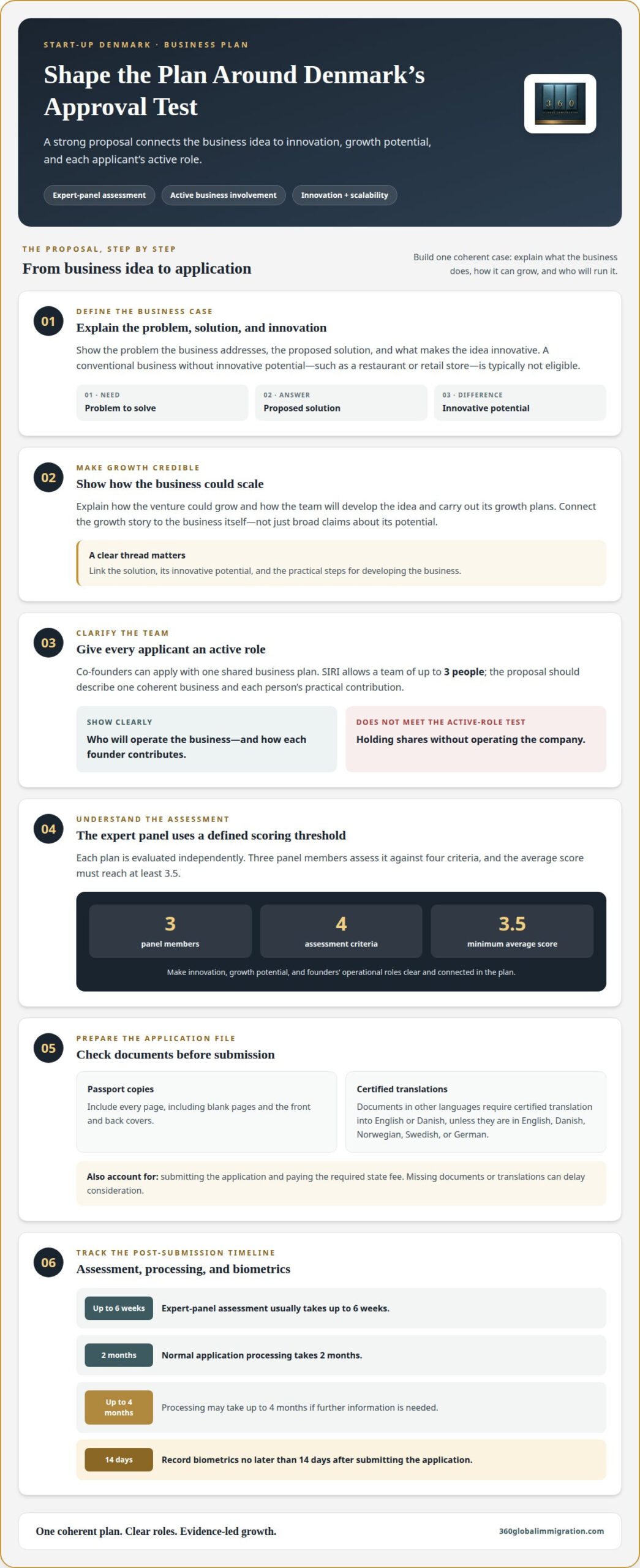
A business plan for Denmark’s startup visa should explain the problem, the proposed solution, its innovative potential, and how the business could grow. It should also show how you will actively run the business. A passive financial interest, such as holding shares without operating the company, does not meet this active-role requirement.
Conventional businesses without innovative potential, including restaurants and retail stores, are typically not eligible. A proposal that fails to demonstrate innovation, growth potential, or your operational involvement may therefore face a higher risk of rejection.
Co-Founder Applications and Limits
Co-founders can apply together by submitting one shared business plan. According to the Danish Agency for International Recruitment and Integration (SIRI), a team may include up to 3 people.
The proposal should present a coherent business, not separate ventures, and explain each founder’s practical contribution. Every applicant must be involved in running the business; a co-founder who is only a shareholder may not meet the active-participation requirement. Clear roles help the panel understand how the team will develop the idea and carry out its growth plans.
The expert panel assesses business plans independently. Three panel members evaluate each plan against four criteria, and the average score must be at least 3.5. A weak explanation of innovation, growth, or the founders’ roles can make approval harder; the plan should connect these elements clearly rather than rely on broad claims.
After preparing the proposal, applicants submit the application and pay the required state fee. The expert panel assessment usually takes up to 6 weeks. Normal application processing takes 2 months, but it may take up to 4 months if further information is needed. Applicants must record their biometrics no later than 14 days after submitting the application.
Documents in languages other than English, Danish, Norwegian, Swedish, or German require certified translation into English or Danish. The application also requires a copy of every passport page, including blank pages and the front and back covers. Missing documents or translations can delay consideration.
Children under 18 who live at home may receive a residence permit with the applicant. Applicants bringing family members must provide documents showing they can support them financially. The application also requires payment of a state fee.
Financial self-sufficiency requirements
Start-up Denmark treats personal self-support and business financing separately. Entrepreneurs must document funds to support themselves during their first year in Denmark, while the business plan explains how the venture can establish and sustain its operations.
The required personal amount depends on who accompanies the applicant. At the 2025 level, a single applicant must document DKK 153,240. An applicant with a spouse must document DKK 306,480; with a spouse and one or more children, DKK 356,904. An applicant bringing one or more children without a spouse must document DKK 203,664. These are distinct household situations, so use the amount that matches the family members included in the application.
For example, an entrepreneur relocating with a spouse should plan to document the spouse-inclusive amount, not the single-applicant threshold. Applicants bringing family members must also show that they can support them financially. Include the relevant evidence with the application rather than relying on projected business revenue as a substitute for personal funds.
Business financing is a separate planning matter. Start-up Denmark has no fixed minimum business investment requirement, so applicants do not need to meet a prescribed investment figure. Instead, explain how the venture will fund its operations, support its development, and pursue growth. Founders or investors can set out available capital and expected funding sources, keeping business resources separate from personal self-support funds.
Before submitting, align the financial explanation across the business plan and supporting documents. Show how personal funds cover the applicant’s first year and how business financing supports the venture’s launch and potential. This distinction helps experts assess both the entrepreneur’s capacity to live in Denmark and the proposal’s financial logic. For guidance with the Denmark Startup Visa application, keep these two financial cases clearly separated.
Residence and work permit duration
A Start-up Denmark residence and work permit may be granted for up to 2 years. That initial period shapes the operating timeline: the business plan should connect launch activities, product development, and market growth to a realistic schedule. The permit is tied to residence and work in Denmark, so its duration matters when planning the applicant’s involvement in the venture. It also gives founders a clear period to organize business milestones without treating long-term permission as automatic.
A permit may be extended for up to 3 years at a time. An extension is a separate application, not an assumption to build into the business forecast. To continue running the business in Denmark, the extension application must be filed before the current residence permit expires. Founders should therefore set an internal renewal milestone well ahead of expiry and prepare the business information needed to explain continued operations. A late filing can affect the ability to keep running the venture under the existing permit.
Passport validity can also limit the residence period. A Danish residence permit may be valid only until 3 months before the passport expiry date. For example, if a passport expires before the planned permit period ends, the permit’s validity may be shorter than the intended business timeline. After renewing a passport, a permit holder may apply to extend the permit no earlier than 3 months before the permit expires. Aligning passport renewal and permit dates helps avoid a gap in planning.
Build key dates into the business plan’s operating calendar. Set out commercial milestones alongside the permit expiry date, passport expiry date, and intended timing for an extension application. The expert panel assesses the business idea, while the residence and work permit has its own duration and renewal requirements. Economic projections should distinguish early-stage targets from longer-term growth rather than depend on an extension before it is granted. A founder planning to develop a product, secure customers, and expand operations can show how each phase fits the initial permit period, then describe the next stage without presenting renewal as guaranteed.
Innovative business and scalability expectations
Start-up Denmark focuses on business ideas with innovative potential and a credible path to growth. A strong proposal must do more than describe a product: show what makes the solution distinct and how the venture can develop beyond one founder’s efforts. The Danish Business Authority’s expert panel assesses the idea, so explain the business logic clearly instead of relying on labels such as “disruptive.”
Make the innovation tangible. Identify the customer problem, explain how the proposed solution addresses it, and show what sets it apart from existing approaches. For example, a software venture could describe the specific process it improves and how customers would use the product. This illustrates clear explanation, not a guarantee of approval. Link each claim about innovation to the business model and intended users.
Scalability means the model can grow in a practical, repeatable way. Explain how the venture could serve more customers, enter additional markets, or expand its offering without relying solely on one founder’s time. For example, a plan might describe how a digital service could reach customers in other countries and identify the staff, partnerships, or resources needed to support that growth. Keep your ambitions consistent with the proposed operations.
Explain how the business could integrate into the Danish market. Identify target customers, describe how you will reach them, and show how the product or service meets their needs. If language affects sales or delivery, state which language the business will use and why. Tie each growth step to a clear commercial purpose, such as testing demand before entering another market. This gives the panel a grounded picture of local relevance and wider potential.
Traditional restaurants and retail stores without innovative potential are typically not eligible under the scheme. A conventional model should not be relabelled as innovative; the proposal needs a genuine point of difference and a credible growth rationale. Strengthen your Denmark startup visa business plan by making those links clear and consistent.
360 Global Immigration: Denmark Startup Visa
360 Global Immigration supports applicants pursuing the Denmark Startup Visa, helping them bring the business proposal and application requirements into a clear, coherent case. Its guidance is most relevant when you’re assessing whether your business idea fits the scheme, refining how you present innovation and scalability, or preparing supporting documents for submission.
A well-structured application connects the business model, your active role, financial planning, and proposed growth. 360 Global Immigration can guide you through the Denmark Startup Visa process with those elements in view. If your plans involve another route, its offerings also include the France Passeport Talent, UK Innovator Founder Visa, and Netherlands Self Employed Visa.
Contact 360 Global Immigration to discuss your Denmark Startup Visa application.
Turn your proposal into a clear next step
Your next step is to make the proposal tell one consistent story: the business opportunity, your role in developing it, and the evidence supporting your plans. A business plan for Denmark startup visa should be more than an application document; it should clearly communicate your venture’s purpose and direction.
If you’re ready to refine your case, 360 Global Immigration can guide you through the Denmark Startup Visa process. Its other business immigration offerings include France Passeport Talent, UK Innovator Founder Visa, and Netherlands Self Employed Visa, for applicants considering different destinations or pathways.
Contact 360 Global Immigration to discuss your next step. A considered plan can help you move forward with greater focus and confidence.
Frequently Asked Questions
Can my family come with me?
Yes, eligible family members can accompany you under Start-up Denmark. Your children may receive residence permits if they are under 18 and live at home. Include family members in your plans early, since their applications require documentation showing you can support them financially. For example, a family relocating together should account for each accompanying member when preparing its supporting documents.
How long can I stay in Denmark?
Your stay is governed by the validity of your Danish residence permit. An initial Start-up Denmark permit may be granted for up to 2 years. Your passport can affect the permitted stay: the Danish residence permit may end 3 months before your passport expires. Keep both expiry dates in view when planning business operations and your residence in Denmark.
How long is the permit, and can I extend it?
The initial residence and work permit may cover up to 2 years, and extensions may be granted for up to 3 years at a time. To keep running your business in Denmark, submit an extension application before your current permit expires. After renewing your passport, you may apply to extend the permit no earlier than 3 months before its expiry.
What are my rights if I am granted a permit?
A Start-up Denmark permit gives you permission to reside and work in Denmark under the approved business basis. It also allows travel in the Schengen area for up to 90 days within the latest 180-day period. That travel allowance does not give you permission to work in other Schengen countries. Keep your business activity and travel plans consistent with those limits.
What are the conditions?
You must actively run the business rather than hold only an economic or financial interest, such as shares. The business idea must receive expert-panel approval and demonstrate innovative potential. If the nature of your business changes substantially after you arrive, notify SIRI and reapply for a residence and work permit. A passive investor alone does not meet the active-role requirement.
What more do I need to know before I apply?
Create a case order ID, pay the processing fee, and submit your application in the same calendar year. Record your biometrics no later than 14 days after submission. Include a copy of every passport page, even blank pages and both covers. Documents in other languages may require certified translation into English or Danish, so organize the application materials before submission.